
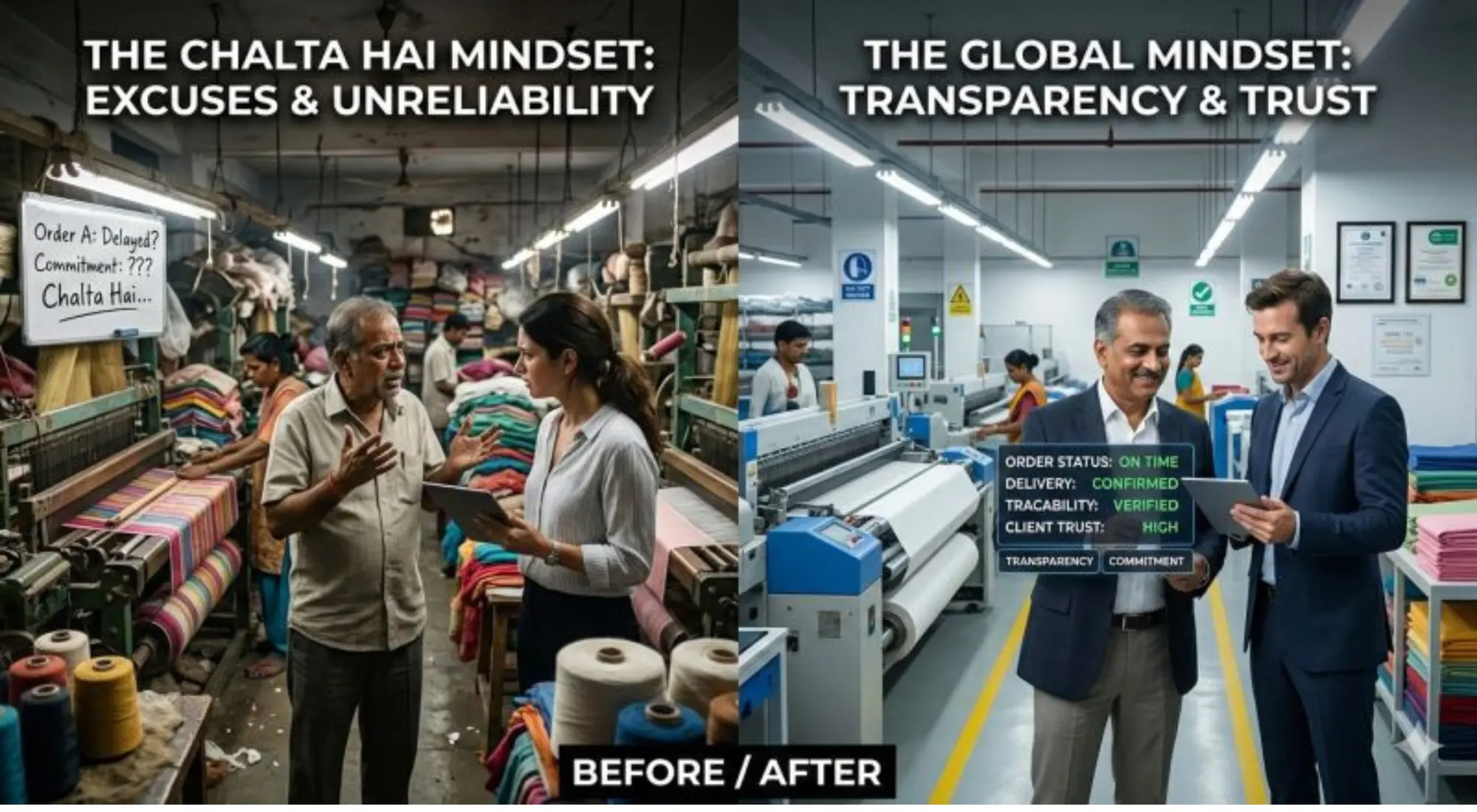
The Chalta Hai Tax Why Indias Textile SMEs Are Failing the Global Trust Audit
Returning on a flight from Ahmedabad I had this thought circling my mind
The Paradox
India has secured some of the worlds best FTAs with the UK EU and Australia along with PM MITRA Parks and strong PLI incentives Yet global buyers are still hesitant to shift quick delivery orders or large volume production to India
The Diagnosis
It is not a policy failure it is a DNA defect
For decades the Indian textile SME sector has operated on a survivalist mindset that is now limiting global scale To become a 350 billion dollar industry by 2030 we must address three hard truths
1 The Yes Man Transparency Trap
SMEs often over commit on manufacturing capabilities to secure orders hoping to manage execution later In a world of real time tracking an opaque supply chain is a deal breaker
Global standard Radical honesty about capacity versus the Indian reality Adjust ho jayega meaning we will manage
2 The Cost of Fluid Timelines
In the era of fast fashion and ultra lean inventory even a three day delay creates financial loss across the value chain The Chalta Hai mindset toward delivery timelines is one of the main reasons Indian SMEs are treated as backup options rather than primary partners
3 Compliance as a Fine Not a Foundation
Many promoters view ESG environmental social and governance and traceability as a compliance burden rather than a core business function For global buyers non compliance is a serious risk indicator
The Strategic Ask
1 A Global Stage Leadership Program for every SME
Infrastructure is only as effective as the people operating it There is a need to move from subsidy only models to capability first training
2 A National SME Excellence Initiative focused on
Professional project management moving from family led to system led operations
The integrity dividend understanding that over promising and under delivering weakens Brand India
Digital trust architectures enabling SMEs to use blockchain and IoT to create transparency and build competitive advantage
The Bottom Line
The government has built the pitch and FTAs have provided the stadium But without fixing internal DNA we risk remaining spectators in our own growth story
Giriraj Singh Piyush Goyal Rohit Kansal A Sakthivel Chairman AEPC Shaleen Toshniwal Apparel Export Promotion Council MATEXIL Manmade and Technical Textiles Export Promotion Council Formerly SRTEPC Confederation of Indian Textile Industry CITI
TextileIndustry MSME IndiaExports SupplyChainTrust MinistryOfTextiles IndustrialTransformation Vikshitbharat2047